by Christopher Hart | Feb 25, 2026 | Blog
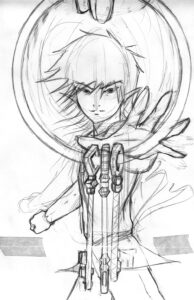
Many beginners draw carefully with light, choppy lines. That’s a tough way to make progress. Instead, try drawing with loose, bold, confident lines. “But…what if I make a mistake?” Here’s the thing. Your first attempt shouldn’t be your final drawing. It’s constricting. It chokes off your creativity. First, make a messy sketch. Next, use it as the basis your final drawing. I hope that was helpful to you.
by Christopher Hart | Feb 10, 2026 | Blog
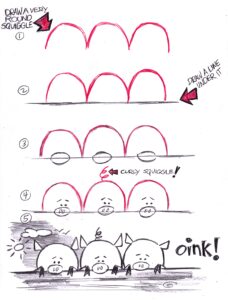
How do you come up with an idea? It doesn’t have to explode into being all at once. Sometimes, it starts as an inkling. But if you follow it where it wants to go, and extend it some more, you may have transformed the ordinary into something cool.
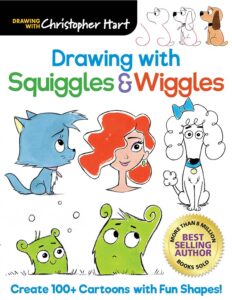
In this example, I sketched a rough drawing of a pig, then another, and another, and the more pigs I sketched the funnier it got, until it became a book called, “Drawing with Squiggles and Wiggles.”
by Christopher Hart | Jan 26, 2026 | Blog
Everyone wants their work to stand out and be noticed. So naturally, you’ll want to create an inventive submission to send to an agent or a publisher right? WRONG! Agents and publishers receive hundreds and sometimes thousands of submissions a month. To make the job of wading through all this material easier, they generally have listed the format in which they want to receive it on their website. And they really want it that way – exactly that way.
You might be thinking, “I bet they’ve never see a proposal in this format.” But the agent and publisher may be thinking, “This guy can’t even follow a few, simple directions. What’s going to happen if I match him with an editor?” Let your writing and artwork be inventive. But follow the instructions when submitting a package.
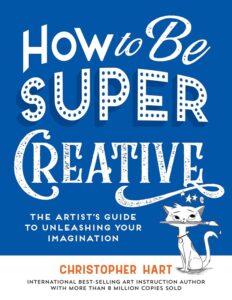
More on this in my book, “How to Be Super Creative,” which you can get on Amazon.
by Christopher Hart | Jan 12, 2026 | Uncategorized
Are you looking to be more creative in your art, but aren’t sure how to to it? The answer might not be in the resourcefulness of your drawing ability, but in the concept you begin with.
For example, suppose you were to draw a beautiful character. Well, a lot of people start with something lean like that. But it doesn’t inspire much in the creativity department. But if you were to take the same subject and and tweak the concept, it would come to life.
For example: a beautiful character which is an A.I. robot who is in love with a human who doesn’t want a robot relationship.
Key point: it’s all in the approach.
by Christopher Hart | Jan 7, 2026 | Blog
Everyone needs feedback on their work. But whom to ask is the question.
It may be better to ask a non-pro than a professional. That’s because the average viewer is your audience, whereas the professional artist’s feedback may get technical and in the weeds.
If a person can’t articulate an opinion on your work, help them out by asking specific questions.
For example, you may not be sure that the expression you drew reads clearly. Ask them what they think the character’s expression means. You never have to take anyone’s advice, but sometimes it’s just what you need.

by Christopher Hart | Dec 29, 2025 | Blog
Here are some possibilities to consider:
- Animation, including character design, storyboard, animating, writing, and backgrounds
- Licensed art. This refers to marketing your own character(s) or designs for – or on – products, often through art licensing agents. Such items could include sportswear, snack foods, baby accessories, flatware, figurines and more.
- Graphic novels
- Comic books
- Children’s book illustration
- Illustration for advertising and branding, often through an artists’ representatives
- Webstrips
- Toy design
- Theme parks
Many artists even create their own specialties!
by Christopher Hart | Dec 22, 2025 | Blog
Foolish mortal. Of course you do. And I am going to show you how. Like you, I’m a pretty busy person. It’s hard to find time for creative sketching or character design after you’re done with your work. Actually, it’s pretty easy. Here’s how:
Let’s say it’s dinner. You take your tray of food and place it in front of the television. Place a few drawing supplies on the coffee table before you. Put on your favorite show but don’t watch it. That’s right. Listen to it while you draw. It makes sketching easier because you’re not trying so hard. Your mind is elsewhere but your hand is drawing.
Now that you know the secret, you can’t tell anybody. Now go draw, and enjoy the show!
by Christopher Hart | Dec 15, 2025 | Blog
It hits every artist sometime. The Inertia Fairy lands on your drawing pad and drives you crazy. You can’t think of what to draw. What should you do?
I’ll tell you what not to do: Don’t wait for the Inertia Fairy to fly away. Artists often believe they must “feel it” to draw it. Here’s the trick: you don’t feel creative? Draw anyway. Draw anything. Making mistakes? Oh well. Keep drawing. Soon, and most likely very soon, something will click, and you’ll be on your way.
“Wait, you’re not saying you should just force creativity, are you?”
“That’s exactly what I’m saying.” Give yourself a push in the right direction. See if it works for you, and let me know.
Until next time,
Christopher Hart
by Christopher Hart | Dec 8, 2025 | Blog
When you decide to draw a new character, your intention is to transfer what’s in your mind onto paper or tablet. But as you begin to draw, you notice that the character takes a few twists and turns and doesn’t look exactly like what you had in mind.
People make all sorts of corrections at this point – but don’t fight it. This is a good development. The character is trying to tell you that while it appreciates the starting point you came up with, it has a better idea of who it wants to be.
Give it some rein. You can always change it back later.
After all, you have an eraser and it doesn’t!
by Christopher Hart | Nov 24, 2025 | Blog
- Do you make faces while drawing a character’s expression?
- Do you go through angst about changing a drawing even though you know it needs it?
- Do you add personality to your characters by changing the hair, pose or clothes?
- Do you focus expressions on the eyebrows rather than on the eyes?
- When you reassess a drawing, do you imagine what your character might be thinking?
- Do you try to keep a group of characters within a consistent style?
If you answered “Yes” to any of these questions, you’re exhibiting artistic traits well above the average hobbyist. You, my friend, are a cartoonist!