by Christopher Hart | Feb 25, 2026 | Uncategorized
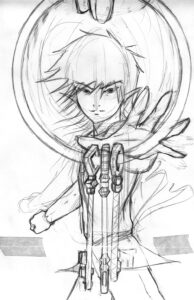
Many beginners draw carefully with light, choppy lines. That’s a tough way to make progress. Instead, try drawing with loose, bold, confident lines. “But…what if I make a mistake?” Here’s the thing. Your first attempt shouldn’t be your final drawing. It’s constricting. It chokes off your creativity. First, make a messy sketch. Next, use it as the basis your final drawing. I hope that was helpful to you.
by Christopher Hart | Feb 10, 2026 | Blog
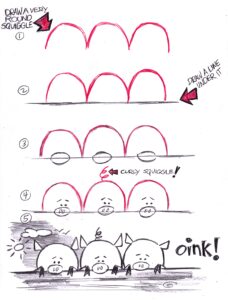
How do you come up with an idea? It doesn’t have to explode into being all at once. Sometimes, it starts as an inkling. But if you follow it where it wants to go, and extend it some more, you may have transformed the ordinary into something cool.
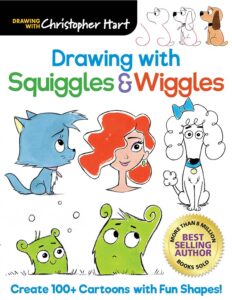
In this example, I sketched a rough drawing of a pig, then another, and another, and the more pigs I sketched the funnier it got, until it became a book called, “Drawing with Squiggles and Wiggles.”
by Christopher Hart | Jan 26, 2026 | Blog
Everyone wants their work to stand out and be noticed. So naturally, you’ll want to create an inventive submission to send to an agent or a publisher right? WRONG! Agents and publishers receive hundreds and sometimes thousands of submissions a month. To make the job of wading through all this material easier, they generally have listed the format in which they want to receive it on their website. And they really want it that way – exactly that way.
You might be thinking, “I bet they’ve never see a proposal in this format.” But the agent and publisher may be thinking, “This guy can’t even follow a few, simple directions. What’s going to happen if I match him with an editor?” Let your writing and artwork be inventive. But follow the instructions when submitting a package.
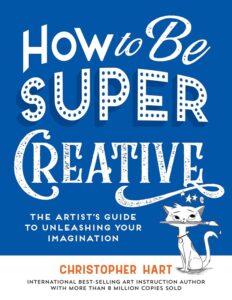
More on this in my book, “How to Be Super Creative,” which you can get on Amazon.
by Christopher Hart | Jan 12, 2026 | Uncategorized
Are you looking to be more creative in your art, but aren’t sure how to to it? The answer might not be in the resourcefulness of your drawing ability, but in the concept you begin with.
For example, suppose you were to draw a beautiful character. Well, a lot of people start with something lean like that. But it doesn’t inspire much in the creativity department. But if you were to take the same subject and and tweak the concept, it would come to life.
For example: a beautiful character which is an A.I. robot who is in love with a human who doesn’t want a robot relationship.
Key point: it’s all in the approach.
by Christopher Hart | Jan 7, 2026 | Blog
Everyone needs feedback on their work. But whom to ask is the question.
It may be better to ask a non-pro than a professional. That’s because the average viewer is your audience, whereas the professional artist’s feedback may get technical and in the weeds.
If a person can’t articulate an opinion on your work, help them out by asking specific questions.
For example, you may not be sure that the expression you drew reads clearly. Ask them what they think the character’s expression means. You never have to take anyone’s advice, but sometimes it’s just what you need.